
The Rise of AI-Powered CRMs: How AI is Revolutionizing Sales and Customer Relationships

Sales teams are embracing AI-powered CRM and sales automation to transform customer relationships and accelerate lead generation. Traditional CRMs have long supported sales efforts by organizing data, but today’s AI-driven CRMs are actively reshaping the sales landscape—automating engagement, qualifying leads, and predicting conversions with unmatched accuracy.
With AI SDRs (Sales Development Representatives), companies can process 10-15x more leads, boost email open rates by 40%, and cut costs per qualified lead by 70%. As competition intensifies, businesses must evaluate AI-native solutions like OpenAI’s AI SDRs alongside established CRM leaders like Salesforce Einstein AI.
This article explores how AI-powered CRM and sales automation are redefining the future of customer engagement, the competitive battle between OpenAI and Salesforce, and the roadmap for businesses seeking faster, smarter, and more cost-effective sales operations..
Key Insights:
- AI SDRs process 10-15x more leads than human SDRs—managing up to 3,000 leads per month.
- Customer engagement is improving, with AI-powered emails achieving a 40% higher open rate and a 28% better response rate.
- Cost efficiency is skyrocketing, reducing the cost per qualified lead by 60-70% while improving accuracy by 37%.
- AI-native CRMs are competing with industry giants like Salesforce, leveraging autonomous sales agents for 24/7 lead generation.
This article explores how AI is reshaping CRM, its competitive impact, and how businesses can prepare for this transformation.
The Evolution of AI in Sales Operations
Traditional sales operations have been bogged down by repetitive manual tasks—cold outreach, lead qualification, and scheduling follow-ups. AI-powered CRMs are transforming these areas, automating workflows, and allowing sales teams to focus on high-value tasks.
AI-Powered Lead Generation and Qualification
AI-driven systems can now:
- Analyze behavioral data across multiple channels to detect purchase intent.
- Score leads with advanced AI models that consider hundreds of variables.
- Enrich contact data automatically using external data sources.
- Forecast conversion probability using predictive modeling.
Automated Communication and Engagement
AI SDRs and chatbots enable:
- Personalized email sequences that adapt based on recipient behavior.
- Automated meeting scheduling based on calendar availability.
- Smart follow-ups that adjust based on customer engagement.
- AI-driven content recommendations for sales funnel optimization.
Predictive Analytics and Sales Insights
- Churn prediction: AI detects warning signs and triggers retention strategies.
- Customer lifetime value (CLV) forecasting: AI predicts future spending.
- Pipeline optimization: AI refines sales processes based on real-time data.
- Market trend analysis: AI anticipates shifts in consumer behavior.
The AI Assistant Revolution: OpenAI’s AI SDRs
AI-powered Sales Development Representatives (SDRs) are redefining how businesses approach customer acquisition. These AI-driven assistants autonomously handle lead engagement, qualification, and scheduling.
AI SDR Performance Metrics
1. Lead Processing Capacity
- Human SDRs: 100-200 leads per month
- AI SDRs: 2,000-3,000 leads per month (10-15x increase)
- Response time: Reduced from hours to seconds (96% improvement)
2. Engagement Metrics
- Email open rates: +35-40% through AI-optimized timing.
- Response rates: +28% via AI-personalized content.
- Meeting booking rates: +22% using intelligent AI follow-ups.
3. Cost Efficiency
- Cost per qualified lead: Reduced by 60-70%.
- Operational costs: Cut by 45-50%.
- Training costs: Eliminated (human SDRs take 3-4 months to ramp up).
4. Quality Metrics
- Lead qualification accuracy: +37% improvement.
- Customer data accuracy: +42% improvement.
- Sales pipeline forecast accuracy: +31% improvement.
Case Studies: Real-World AI SDR Success
Industry
Challenge
Solution
Impact
SaaS (B2B)
Slow lead response times, low engagement
AI SDRs for real-time lead follow-up
50% increase in lead conversions, 3x more meetings booked
E-Commerce
Customer engagement was inconsistent across campaigns
AI-generated personalized follow-ups and recommendations
40% increase in repeat purchases, 60% faster response times
Real Estate
Delays in responding to property inquiries led to lost sales
AI-driven lead engagement with automated follow-ups
35% higher engagement, 25% more closed deals
The Competitive Landscape: OpenAI’s AI SDR vs. Salesforce Einstein AI
The battle for AI-powered CRM dominance is intensifying between OpenAI’s AI SDR and Salesforce’s Einstein AI. Both platforms leverage artificial intelligence but take vastly different approaches to sales automation, lead qualification, and customer engagement.
🚀 OpenAI AI SDR: The Fully Autonomous Approach
- OpenAI’s AI SDR functions as an independent digital salesperson that can qualify leads, engage prospects, and book meetings without human oversight.
- It uses advanced LLM-based decision-making, making real-time adjustments to its engagement strategies.
- It scales seamlessly, managing 3,000+ leads per month with human-like interactions.
🏢 Salesforce Einstein AI: The Assisted AI Model
- Einstein AI acts as a powerful AI assistant for human sales teams, enhancing workflows rather than replacing SDRs.
- It primarily relies on rule-based automations to guide sales teams, providing predictive insights and recommendations rather than autonomous execution.
- While highly integrated within the Salesforce ecosystem, it still requires human intervention for complex sales strategies.
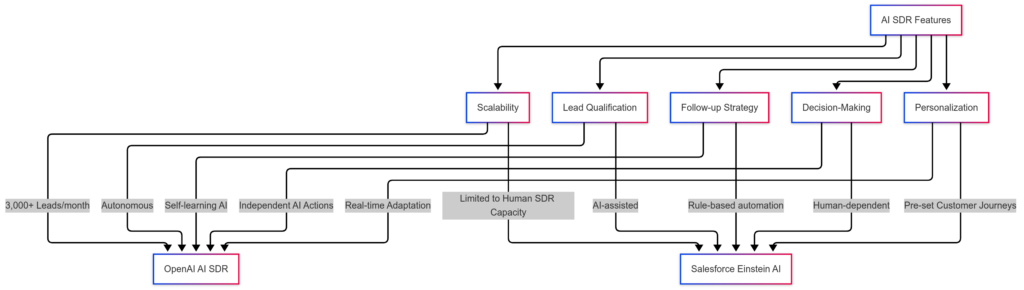
📊 AI SDR vs. Salesforce Einstein AI: Competitive Feature Breakdown
Feature
OpenAI AI SDR
Salesforce Einstein AI
Lead Qualification
Fully Autonomous
AI-Assisted (Human Required)
Follow-up Strategy
Self-learning AI
Rule-Based Automation
Decision-Making
Independent AI Actions
Human-Dependent Decision Making
Personalization
Real-time Adaptation
Pre-set Customer Journeys
Scalability
Handles 3,000+ leads/month
Limited by Human SDR Capacity
Integration
API-first, Flexible
Deep Salesforce Integration
Pricing Model
SaaS Subscription (Lower TCO)
Enterprise Licensing Fees (Higher TCO)
Key Takeaways:
✅ OpenAI AI SDRs are fully autonomous and designed for companies looking for high-volume, automated sales pipelines.
✅ Salesforce Einstein AI is ideal for businesses that want AI-driven insights but still rely on human-led sales interactions.
✅ Hybrid solutions—combining Salesforce’s CRM analytics with OpenAI’s AI SDR automation—offer a balanced approach for enterprise-level sales teams.
Hybrid AI-Human Sales Workflow: The Best of Both Worlds
While fully autonomous AI SDRs can revolutionize sales, many companies prefer a hybrid approach, where AI assists human sales teams rather than replacing them entirely.
The AI-human hybrid model follows a structured workflow where AI SDRs handle lead engagement and qualification, while human sales teams close high-value deals.

📌 AI-Human Collaboration Breakdown
Stage
Handled by AI SDR
Handled by Human Sales Team
Lead Identification
AI scrapes data and scores leads
Sales reps verify high-value leads
Initial Outreach
AI SDR sends personalized emails
Human reps engage priority leads
Follow-Ups & Nurturing
AI SDR automates re-engagement
Sales reps handle objections
Meeting Scheduling
AI SDR books appointments
Sales reps lead live conversations
Deal Closing
AI SDR provides insights
Sales team closes contracts
Key Takeaways:
✅ AI SDRs eliminate lead qualification bottlenecks, saving sales teams hundreds of hours per month.
✅ Sales teams handle strategic deal-making, where human intuition is irreplaceable.
✅ Companies adopting this model report a 40-60% boost in conversion rates while reducing manual sales effort.
📌 ROI Timeline & Break-even Analysis: How Fast Can AI SDRs Deliver Value?
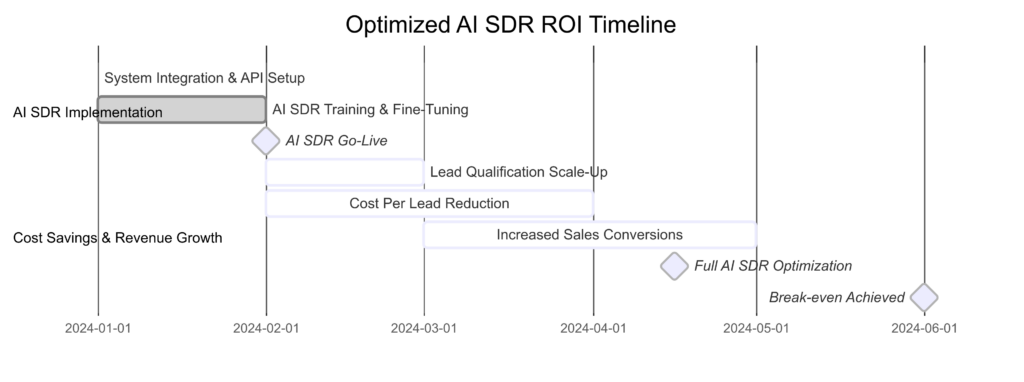
One of the biggest concerns for businesses implementing AI SDRs is how long it takes to see ROI. The good news? AI-powered CRM automation has a short implementation timeline and rapid return on investment.
🚀 Optimized AI SDR ROI Timeline
📊 AI SDR ROI Breakdown
Metric
Human SDRs
AI SDRs (OpenAI AI SDR)
Avg. Monthly Leads Processed
200
3,000+
Cost per Lead
$50+
$15-$20
Avg. Time to Follow-Up
4-6 Hours
5-10 Seconds
Training & Ramp-up Time
3-4 Months
1-2 Weeks
ROI Break-even Period
9-12 Months
6 Months
Key Takeaways:
✅ AI SDRs deliver ROI 3-6 months faster than traditional sales development teams.
✅ Lead acquisition costs drop by 60-70%, while lead volume scales exponentially.
✅ Businesses that adopt AI SDRs see immediate improvements in follow-up efficiency, conversion rates, and overall sales velocity.
🚀 Final Recap & Strategic Takeaways
✅ AI SDRs Are Redefining Sales Automation
- OpenAI’s AI SDRs operate independently, handling lead engagement at scale.
- Salesforce Einstein AI enhances human sales teams, offering AI-powered insights.
- Hybrid AI-human workflows maximize efficiency, letting AI handle repetitive tasks while humans focus on closing deals.
✅ ROI Justification for AI SDR Implementation
- AI SDRs deliver ROI in just 6 months.
- Cost savings reach 60-70% while sales teams scale operations faster.
- Early adopters see lead engagement increase by 40%+ and conversion rates improve by 50%.
💡 What’s Next?
Would you like a customized AI SDR implementation strategy for your business? 🚀
Related Articles
- AI and Automation
How AI Deep Research Tools Are Reshaping Business Intelligence: A Practical Implementation Guide for 2025
Discover how AI deep research tools are revolutionizing business intelligence. Learn how to implement AI-powered research, measure ROI, and choose the right platform for competitive advantage in 2025.
- AI and Automation
Building a Future-Proof Digital Experience Platform: A Technical Deep Dive into Composable CMS Architecture
Discover how Composable CMS Architecture enables scalable, AI-powered, and API-first content delivery. Learn about GraphQL, AWS Lambda, Redis caching, AI personalization, and DevOps best practices for future-proofing your content management system.
- AI and Automation
Outlines: Structured Text Generation for LLM Applications

Discover how Outlines simplifies structured text generation for LLM applications. Learn about its features, structured generation techniques, and integration capabilities to build reliable and efficient AI-powered solutions.
Discussion
Loading discussion...