
KB Microservices: Ethical Impact and AI Development Insights

Artificial intelligence is evolving rapidly, and at the heart of this transformation are Knowledge-Based Microservices (KB Microservices).
Listen to the audio version, crafted with Gemini 2.0.
These modular systems are redefining how AI learns, stores, and applies knowledge, paving the way for groundbreaking applications in healthcare, finance, education, and beyond.
This article explores the technical underpinnings, advanced use cases, real-world examples, and limitations of KB Microservices, providing a comprehensive guide to their implementation and impact.
Introduction: The New Era of Knowledge Management
The journey of AI from data-driven systems to cognitive architectures demands advanced knowledge management solutions. Traditional systems often struggle to provide the flexibility, scalability, and contextual awareness needed for modern applications. Enter KB Microservices: lightweight, decentralized modules that enable efficient knowledge creation, retrieval, and updating, leveraging state-of-the-art large language models (LLMs) like GPT-4.
What Are KB Microservices?
Definition
KB Microservices are modular units within an AI ecosystem designed to manage knowledge dynamically. Unlike monolithic systems, they can scale independently and integrate seamlessly into larger architectures.
Core Functions
- Create: Transform unstructured data (e.g., chat logs, articles) into structured, retrievable knowledge.
- Search: Retrieve relevant knowledge using advanced semantic understanding.
- Update: Revise existing knowledge to ensure accuracy without losing historical context.
Case Study: Enhancing Customer Support with KB Microservices
Background: A global customer service provider integrated KB Microservices into its chatbot system. The goal was to provide consistent, context-aware responses while reducing manual intervention.
Implementation:
- Knowledge Creation: Chat logs and product manuals were converted into structured KB articles.
- Semantic Search: The chatbot retrieved relevant articles dynamically based on user queries.
- Updating: Articles were updated with new product details, ensuring accuracy.
Outcome:
- Response Accuracy: Increased by 30%.
- Customer Satisfaction: Improved by 25%.
- Operational Efficiency: Reduced support team workload by 40%.
Technical Foundations of KB Microservices
Leveraging GPT Models
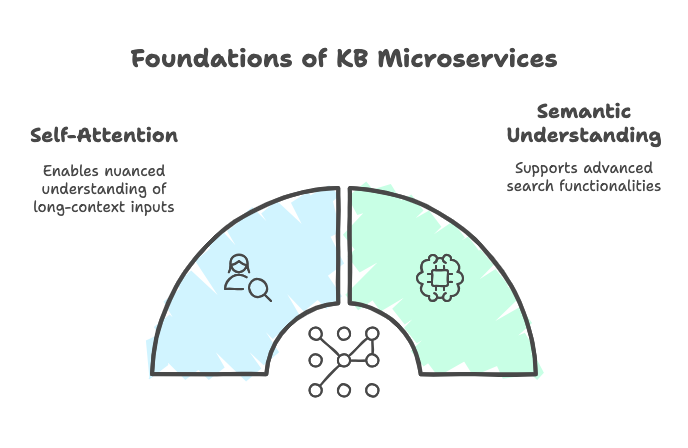
At the core of KB Microservices are transformer-based LLMs like GPT-4. These models serve as interpreters, transforming unstructured data into actionable insights. Their capabilities include:
- Self-Attention: Enables nuanced understanding of long-context inputs.
- Semantic Understanding: Supports advanced search functionalities.
Key Techniques
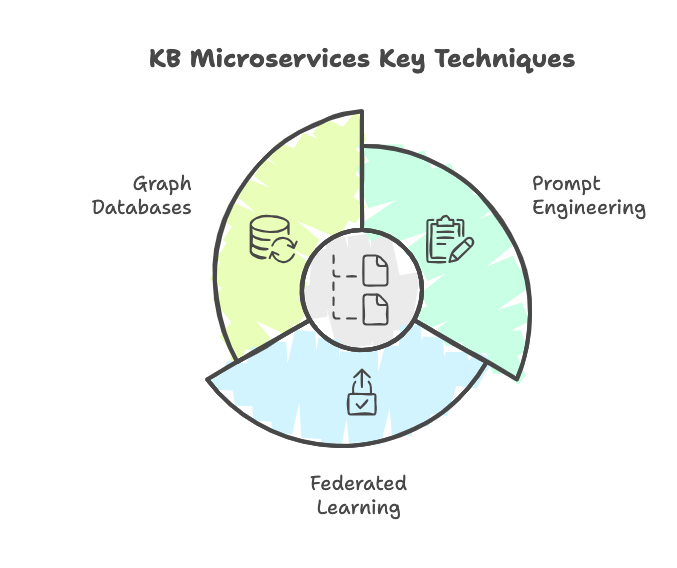
Prompt Engineering:
Well-structured prompts ensure consistent and accurate knowledge generation.
{ "title": "Ethical AI Development", "description": "Exploring key principles of ethical AI.", "keywords": "ethics, AI, transparency", "body": "Developing ethical AI involves addressing fairness, bias, and accountability..." }
Federated Learning:
Decentralized learning allows KB Microservices to improve without centralizing sensitive data.
Example: Localized microservices in healthcare systems can train on regional patient data while maintaining privacy.
Graph Databases:
Represent complex knowledge relationships, enabling advanced reasoning and inference.
Example: Mapping interdependencies in supply chain data to optimize logistics.
Limitations and Challenges
Hallucinations in AI
LLMs like GPT-4 can sometimes generate incorrect or misleading information—a phenomenon known as “hallucination.” This poses challenges for KB Microservices, especially in critical domains like healthcare.
Mitigation Strategies:
- Human Oversight: Expert review of outputs.
- Confidence Scoring: Implementing probabilistic metrics to flag uncertain results.
Maintaining Consistency
As the number of KB Microservices grows, ensuring consistency becomes increasingly complex.
Solutions:
- Centralized Metadata Standards: Enforce uniform data schemas across services.
- Version Control: Track changes and dependencies in KB articles.
Advanced Topics in KB Microservices
Explainable AI (XAI)
Making AI systems interpretable is critical for trust and debugging. In the context of KB Microservices:
- Transparent Search: Show how results were retrieved.
- Explainable Updates: Provide a rationale for knowledge revisions.
Long-Context Capabilities
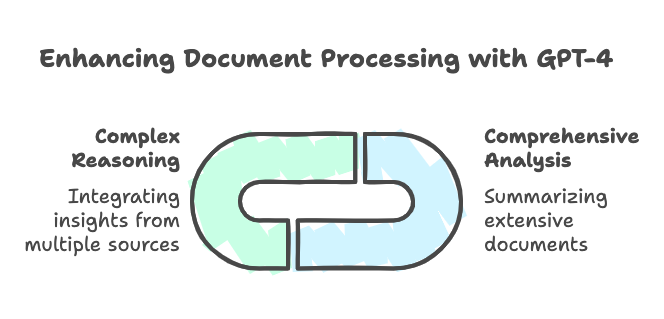
GPT-4’s extended context window (up to 32,000 tokens) allows KB Microservices to process and integrate longer documents, enabling:
- Comprehensive Analysis: Summarizing research papers or legal documents.
- Complex Reasoning: Combining insights from multiple sources.
Addressing Ethical Considerations
Job Displacement
Automation powered by KB Microservices could impact roles in customer service, data entry, and more.
Mitigation:
- Reskilling Initiatives: Train employees for roles that require AI-human collaboration.
- New Opportunities: Promote AI management and integration roles.
Inequality and Access
Advanced AI systems could widen the gap between resource-rich and resource-poor organizations.
Solutions:
- Open-Source KB Microservices: Democratize access to cutting-edge tools.
- AI Education Programs: Build a globally skilled workforce.
Addressing Ethical Considerations: Access Comparison Between Proprietary and Open-Source AI Tools
Aspect
Proprietary AI Tools
Open-Source AI Tools
Cost
High subscription/licensing fees, limiting access for smaller organizations
Free or low-cost, enabling wider adoption and experimentation
Accessibility
Often gated behind corporate partnerships or enterprise licenses
Universally accessible; available to individuals and resource-limited organizations
Customization
Restricted to features permitted by vendors
Fully customizable for niche or local requirements
Transparency
Limited insights into algorithms, creating trust challenges
Fully transparent, allowing auditing and trust-building
Community Involvement
Closed development; limited by vendor resources
Global community collaboration fosters inclusivity and innovation
Scalability
Scales within vendor ecosystems, often with significant costs
Scales across varied infrastructures, with flexibility for all budgets
Data Privacy
Vendor-controlled data storage; may not align with user needs
User-controlled data storage, ensuring compliance with specific privacy requirements
Educational Value
Limited access for learning due to costs
Open platforms offer learning opportunities for global users
Innovation
Driven by vendor priorities
Encourages experimentation and innovation by diverse contributors
Ethical Oversight
Ethics policies determined by vendors, with limited external review
Open for scrutiny, fostering ethical improvements through transparency
Why This Matters:
- Job Displacement and Mitigation: Open-source KB microservices empower smaller organizations and individuals to adapt to changes brought about by automation. They encourage collaboration, innovation, and ethical adoption.
- Reducing Inequality: Open-source solutions ensure that even under-resourced organizations can benefit from cutting-edge AI technologies, bridging the gap between resource-rich and resource-poor entities.
Use Case:
- Corporate Training: To educate teams about the advantages of leveraging open-source tools in mitigating job displacement and inequality.
- Public Advocacy: Demonstrating how democratized access to AI tools can reduce societal disparities.
- Strategic Planning: Helping organizations choose ethical, inclusive AI strategies.
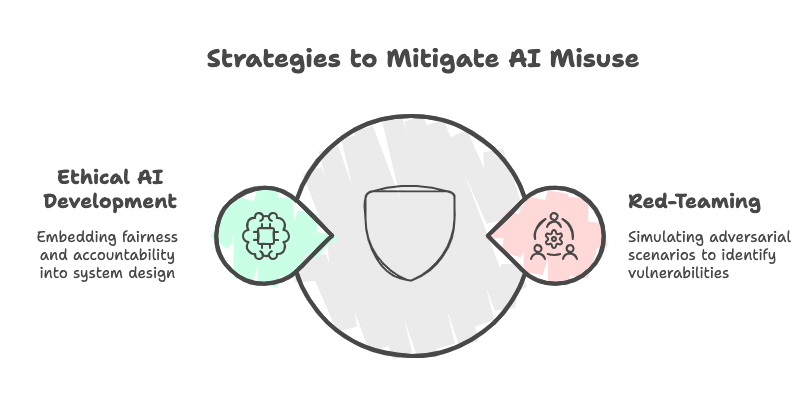
Misinformation Risks
AI-generated content can be weaponized to spread false information.
Approaches:
- Red-Teaming: Simulate adversarial scenarios to identify vulnerabilities.
- Ethical AI Development: Embed fairness and accountability into system design.
The Future of KB Microservices
Human-AI Collaboration
KB Microservices are poised to redefine human-AI interactions:
- Creativity: Enhance artistic endeavors with AI-assisted brainstorming.
- Decision-Making: Provide actionable insights in complex scenarios.
Scaling Across Industries
From personalized education to real-time supply chain management, the potential of KB Microservices is limitless.
Conclusion
KB Microservices represent a paradigm shift in AI, offering scalable, dynamic, and context-aware solutions for managing knowledge. While challenges like hallucinations and ethical considerations persist, the opportunities for innovation far outweigh the risks.
By addressing limitations and fostering collaboration, KB Microservices can unlock new frontiers in cognitive systems, enabling a smarter, more equitable future.
Explore More from Adyog
1. AI Services
Our AI-driven solutions transform industries with advanced machine learning and artificial intelligence techniques. Whether it’s optimizing workflows or building predictive models, we’ve got you covered.
👉 Explore our AI services for more details.
2. Digital Product Development
From ideation to deployment, our team specializes in delivering cutting-edge digital solutions tailored to your business needs. Let us bring your innovative ideas to life.
👉 Discover our digital product development expertise.
3. Design Innovation
Good design drives great user experiences. Learn how our team crafts intuitive and engaging interfaces that resonate with your audience.
👉 Learn about our design innovation approach.
Related Articles
- AI and Automation
Harnessing AI for Social Good: Innovations and Impacts

Artificial intelligence (AI) is increasingly viewed as a positive force addressing global challenges, from enhancing healthcare and education to combating climate change and improving disaster response. By illustrating various applications, this article demonstrates AI's potential to improve lives and tackle urgent issues, fostering hope for a more equitable and sustainable future.
- AI and Automation
AI Agents and Browser Automation: The Coming Disruption of Internet Economics

AI agents like OpenAI’s Operator are reshaping internet economics by automating browsing and decision-making. This deep dive explores the existential crisis facing advertising, content creation, and online platforms in an AI-driven digital economy.
- AI and Automation
OpenAI's O3: A Monumental Leap in AI Reasoning and the Road Ahead

Explore OpenAI's groundbreaking O3 model, its achievements in reasoning benchmarks, self-evaluating capabilities, and the challenges posed by escalating compute costs and safety concerns.
Discussion
Loading discussion...